
Tyres wear out quietly. A set can look perfectly healthy from the driver’s seat while the tread sits only weeks away from the legal limit. Most drivers start thinking about tyre replacement only once a blowout or a failed MOT forces the issue. Knowing what to look for saves money, protects your licence and shortens your stopping distance on a wet road.
Here is how to judge when your rubber has had its day, what the law expects of you, and what actually happens when you book a new set.
The tyre tread depth test that decides it
Tread clears water away from the road surface. Once it wears down, it cannot shift water quickly enough and grip in the wet falls away sharply. The DVSA MOT inspection manual sets the minimum at 1.6mm across the central three-quarters of the tread, measured around the full circumference. Drop below that, and it is illegal, which means an MOT failure, a possible fine and penalty points for every one affected.
The quickest home check is the 20p test. Push a 20p coin into the main grooves at several points around the tyre. If the outer band of the coin stays hidden, you have a reasonable amount of tread left. If the band shows, book a proper measurement, because you are close to the point where tyre replacement stops being optional.
Plenty of drivers wait until 1.6mm because it is the legal floor. Braking performance in the wet starts falling away well above that figure, which is why our technicians tend to flag a tyre once it reaches 3mm. Our full range in Newcastle covers budget through to premium brands, with next day fitting and free safety checks included.
Not sure how much tread you have left? Book a free tyre check with our Newcastle team and get a straight answer in minutes.
Signs your tyres need changing
Tread is only part of the story. These are the faults our fitters see most often:
- Cracking or crazing in the sidewall, usually a sign of age or long spells parked up
- A bulge or blister, which suggests the internal structure has failed and it could let go without warning
- Uneven wear across the tread, often caused by alignment or pressure problems rather than the rubber itself
- One that keeps losing pressure between top ups
- Vibration through the steering wheel at speed
Sidewall damage cannot be repaired safely, so a bulge or a deep cut always means starting fresh. Uneven wear is worth investigating too, because fitting new rubber without correcting the cause simply wears the new set out early. Wheel balancing and tracking form part of every fitting we carry out.
Choosing the right tyres for your car
Once tyre replacement is confirmed, the next question is what to fit. Summer options suit warm weather and dry roads, winter versions give better grip in cold and snowy conditions, and all season tyres perform reasonably well across the year. Run flat variants allow you to keep driving for a short distance after a puncture, which is useful if you have no spare. Eco friendly options reduce rolling resistance for better fuel efficiency, which shows up in your fuel bills over time.
Premium brands from the major manufacturers usually last longer and stop shorter than cheap alternatives, though what suits you best depends on your mileage and budget. Your tyre size is printed on the sidewall, and our team will confirm it before fitting.
So, how often should you replace your tyres?
You may be asking, how often to replace tyres if your mileage is fairly ordinary. There is no single figure, because wear depends on your driving style, your annual mileage and the roads you use. As a working guide, tyres typically last 30,000 to 60,000 miles. Most tyres will need replacement after 5 to 10 years, whatever the tread reads, because rubber hardens and grip drops away with age. The fronts also wear faster than the rears on most cars, so a set rarely reaches the end of its life together.
The practical answer is to check monthly and before any long journey. Tread depth, correct pressure and general condition take five minutes to assess, and this forms part of every car service we carry out. Check tyre pressures every couple of weeks, as regular pressure checks help prolong tyre life and improve safety.
What happens when you book new tyres and tyre fitting
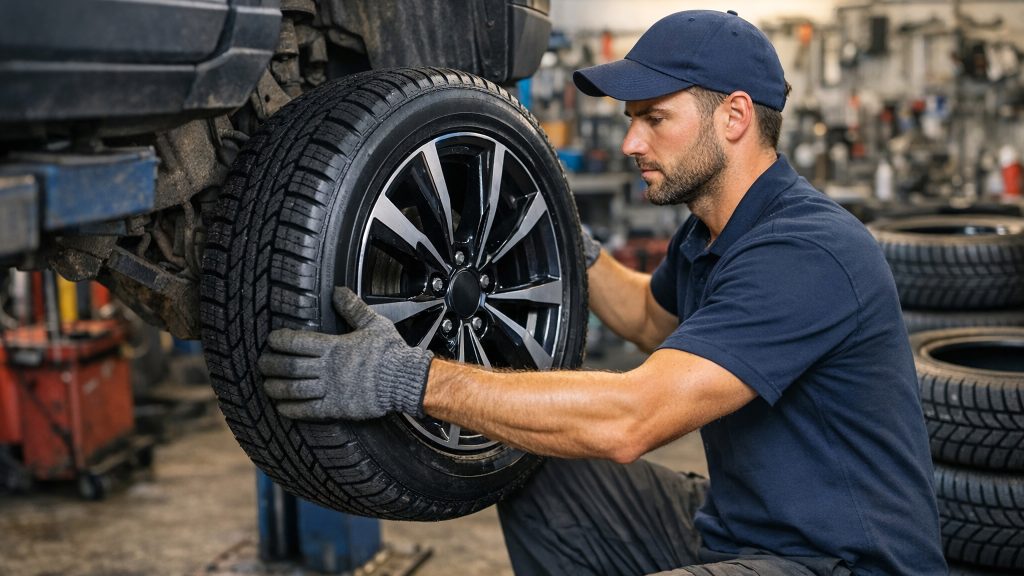
Replacing car tyres is quick when it is done properly. You enter your vehicle registration or size to find the right tyre for your car and driving needs, choose from a range of tyres that runs from budget tyres and mid range options to premium tyres from renowned brands and trusted tyre manufacturers, and pick a fitting slot with same day or next-day service at a local garage where tyres can be fitted locally. We keep tyre prices transparent and offer competitive prices, with local tyre fitting carried out so your tyres are fitted with balancing, valves and checks included. Our technicians then remove the old one, fit the new one, balance the wheel and check pressures, valves and wheel alignment before handing the car back.
Balancing matters more than most drivers expect. An unbalanced wheel sends a vibration through the steering and wears the new rubber unevenly, undoing much of the benefit of the change. If one fails while you are out on the road, our vehicle recovery service can get you and the car back safely. If you get a flat tyre or damaged tyre on the road, a tyre specialist can advise whether replacing tyres is the safer next step.
You can also buy tyres online and have them fitted locally. Ready to sort it? Order online and choose a next day fitting slot at our Newcastle workshop.
Do not forget the spare wheel
If you carry a spare, check its pressure and tread as well, since a flat one is no help at the roadside. Drivers should also inspect the spare wheel regularly for correct pressure and overall condition. A temporary space saver spare has a maximum speed limit, usually around 50 mph, so it is a get-you-home solution rather than a replacement. Before changing a wheel at the roadside, secure the vehicle, turn on your hazard lights and apply the handbrake. Loosen the wheel nuts while the vehicle is still on the ground, then jack the car up only at the manufacturer’s specified jacking point. Once fitted, the spare tyre should be mounted securely and the wheel nuts tightened in a star pattern. Bring your locking wheel nut key to any fitting appointment, because we cannot remove locking wheel nuts fitted to your car without it.
Tyre replacement in Newcastle upon Tyne
We have fitted tyres for drivers across Heaton, Byker, Wallsend, Jesmond and the wider North East for years, and our advice never changes: replace before you reach the limit, not after. Worn rubber shows up in the MOT test anyway, and a tyre replacement done on your terms costs far less than one arranged at the roadside on a wet Tuesday night. If availability allows, tyres can be fitted locally on a same day basis at our Benfield Road workshop.
Whether you need a single tyre after a puncture or a full set before winter, our team talks you through the options honestly. A price match guarantee and free puncture repairs make us one of the garages that tyres Newcastle drivers come back to. You can see everything we offer on our vehicle services page. You can buy tyres online and have them fitted locally at our Benfield Road workshop or local garage.
Tyre replacement is one of the simplest ways to keep your car safe, and we make it painless. Visit Premier Vehicle Care to browse our wide range of tyres, with premium tyres available for drivers who want leading-brand performance and budget tyres for drivers focused on value, or contact our Newcastle team on 0191 2400 700 for honest advice on the right tyres for your vehicle.
Key takeaways
- The legal minimum tread depth in the UK is 1.6mm across the central three-quarters of the tyre, and most specialists suggest changing at around 3mm to maintain safe tyre tread.
- Age matters as much as mileage. Rubber hardens over time, so most tyres may need inspection or replacement within 5 to 10 years even when the tread still looks healthy.
- Cracks, bulges, uneven wear and repeated pressure loss all point towards tyre replacement rather than a repair, and checking the correct tyre pressure regularly improves safety and helps tyres last longer.
- A free tyre check takes minutes and removes the guesswork entirely.


